Showing posts with label computer. Show all posts

Friday, December 14, 2012

Classic British Computers Live Again

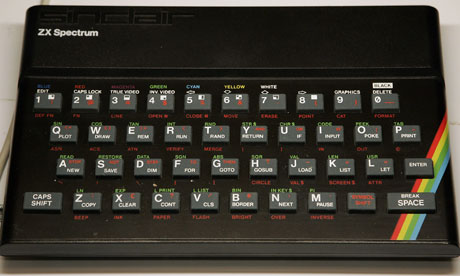
Those who grew up in Britian and Europe in the 80's and early 90's know all about the ZX Spectrum and Amstrad CPC.

Most people who owned one remember the Sinclair Spectrum and CPC as their gateway to the world of personal computers with big name developers like Rareware and the famous composer Jesper Kyd starting as humble home computer developers and composers respectively on them.

 Source: theguardian.co.uk

Both of these home computers had their own particular charm. The Spectrum was not designed for gaming but developers released some fantastic titles anyway despite the impediment of a lack of dedicated video. This meant games could only really display a few colours at a time from a total of seven. The CPC is remembered for its games with bright, bold colours and the unique Amstrad monitor.

Source: serious.gamesclassification.com
Games like Fantastic Dizzy, Firebird, Manic Miner, Wizball and ports of popular arcade and home console games like Commando, Altered Beast and Ikari Warriors led to the CPC and Spectrum becoming beloved amongst home computer users in the 80's and early 90's. Magazines that catered to hobbyist game and operating system development and the "demo scene" fueled the fires of fandom amongst Spectrum and CPC users and now their legacy lives on in communities on the internet.

A manifestation of the love the fans of these home computers hold for them is the "fan site" and what better way to celebrate these wonderful pieces of gaming history than to host some of the most beloved games on the system for play in your browser?

World of Spectrum is a huge site dedicated to all things Spectrum. Straight from your browser you can launch hundreds of games, demo discs, educational programs and productive tools. This is a huge time sink and if you love your home computers then you'll get lost in this site for hours.

CPC Box is the home of a really excellent CPC emulator; the site doesn't hold quite an impressive library of titles like World of Spectrum but it does provide the user with a nice big display resembling a CPC monitor and the ability to boot the CPC and play around with the command line in BASIC. This site is a lot of fun to tinker with.

European gamers must have a tonne of great memories of these two classic computer systems, and of the games that molded a generation of players and programmers. Did you grow up with the shrill loading of a Spectrum tape drive? The satisfying clacking of a CPC keyboard? Share some memories with us.

Sunday, April 15, 2012

Two Guys From Andromeda, Together Again

The Two Guys
Coming down the ether, otherwise known as Kotaku, comes word that The Two Guys From Andromeda, aka Mark Crowe and Scott Murphy, are setting up shop to produce a new space-themed adventure game.  They have a pretty good pedigree for this sort of thing, as they were the creators of the original Space Quest graphical adventure games for Sierra.  The SQ games were truly hilarious, spiritual successors of  the SF comedy Hitchhiker's Guide to the Galaxy books by Douglas Adams, and lampooning a wide spectrum of popular culture.

It's especially surprising to see Murphy back in the game, so to speak, considering his little-hidden distaste for the industry that chewed him up and spit him out after the 6th and final Space Quest game, Roger Wilco in The Spinal Frontier, released in 1995.

Details are sketchy at this point, but it does appear that things are pulling together, and the GuysFromAndromeda company is currently hiring talent.  Whether or not the boys are putting together another Space Quest game or some other (ad)venture, one can be assured the laughter will be heard from one end of the galaxy to the other.

For more information on Space Quest and other classic Sierra games, consult your local Dot Eaters article.

Monday, April 9, 2012

Jack Tramiel, 1928 - 2012

Tramiel speaking at the 25th
anniversary of the C64
One of the leading figures of the early computer revolution, Jack Tramiel has passed away at the age of 83.

Born Idek Tramielski in Lodz, Poland, in 1928, Tramiel would survive the horrors of the Nazi invasion and the Auschwitz concentration camp, eventually emigrating to the U.S. and repaying his liberators by joining the U.S. Army in 1948.  While stationed at Fort Dix in New Jersey, Tramiel was put in charge of the office repair department, fixing typewriters.  After leaving the Army in 1952, a $25,000 U.S. Army loan enabled him to open his own typewriter repair shop in the Bronx.  In order to draw some comparisons to large appliance firms with military names such as Admiral and General, Tramiel took the model name of a Opel brand of car he noticed while riding in a taxi one day, and the Commodore Portable Typewriter company was born.

Commodore adding machine
Moving to Canada to capture exclusivity rights in importing Olivetti typewriters, Tramiel set up shop in Toronto and embarked in some shady deals with Canadian financier C. Powell Morgan which almost landed him in jail.  A trip to Japan persuaded Tramiel to enter the burgeoning electronic calculator field, riding to great success on the wave of microprocessor technology. Texas Instruments eventually figured out that it should be making its own devices instead of supplying Commodore with microchips,  and undercut Tramiel's prices with their own brand of calculators.  Vowing to never be trapped by the whims of a supplier, he purchased chip maker MOS Technologies in 1976 and secured Commodore's future as a manufacturer of cheaper electronic devices.

Commodore PET
With the MOS acquisition, Tramiel also got the services of employee Chuck Peddle, a visionary design wizard who built the PET or Personal Electronic Transactor for Commodore, one of the first mass-produced personal computers that entered the market in 1977, along with the Apple II and the TRS-80 from Tandy.  Leverageing the success of the PET, Tramiel pushed his team to create low-cost colour computers, resulting in perhaps his greatest legacy: the blockbusters VIC-20 and Commodore-64.  The 64, in particular, was an enormous success, eventually becoming the greatest selling computer of all-time.  It is incalculable how many games were sold on this platform, and how many game designers cut their teeth on the system.

The incomparable C64
In early 1984, with Commodore at its apex, Tramiel's clashes with company chairman Irving Gould resulted in his ousting from the company.  Ten years later, Commodore itself would pass into oblivion, entering liquidation after a series of disastrous mistakes. A few months after his departure, Tramiel would buy Atari's consumer division from Warner Brothers, desperate to unload the ashes of the once great gaming company, felled by the cratering video game industry.  Tramiel trash-canned planned next-generation game consoles at Atari to focus instead on home computers, but was stymied by his former company's purchase of Amiga, Inc. from under his nose, a company who's Amiga computer line of revolutionary 16-bit computers would help keep Commodore afloat.  Tramiel would fight back with the Atari ST line of 16-bit computers, which powered Atari Corporation through the rest of the decade and into the 90's.  In 1996, Tramiel would merge Atari with a hard drive manufacturer, resulting in the company JTS.
Tramiel and Sons

Leaving behind his wife Helen, as well as their three sons Gary, Sam and Leonard, Jack Tramiel also leaves behind an industry that owes him a great debt for helping to popularize their landscape.

Thursday, March 3, 2011

GDC 2011: Elite Status

Part of the on-going Game Developers Conference is a series of lectures highlighting gaming's past. Yesterday's lecture featured David Braben, who along with Ian Bell developed the space trading game Elite for the BBC Micro computer in 1984, and multiple platforms soon after.


Elite was a watershed game, that laid the foundation for a genre now known as 4X: eXplore, eXpand, eXploit and eXterminate. Other entries into this field of games that followed in the space wake of Elite are: Star Control 2 (Accolade, 1992), X: Beyond the Frontier (1999), Freelancer (Microsoft, 2003), and EVE Online (Crucial, 2003).

Armed with a B&W wireframe graphics engine and the mathematical algorithms to create an almost endless number of galaxies to explore, Braben and his Elite proved the sky was definitely NOT the limit for computer games.